“So, what exactly do you do?”
For years, I never had a comfortable answer to that question.
The honest response sounded confusing.
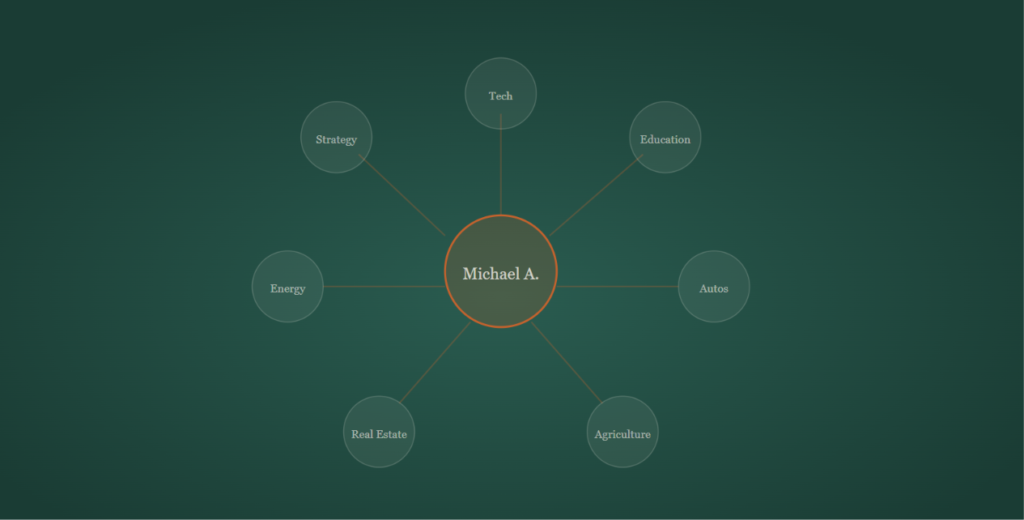
I’m a web developer. I build digital products. I have an interest in real estate. I publish content about automobiles. I rear chickens. I’m interested in agriculture. I enjoy solving business problems.
To many people, that sounds like someone who can’t decide what they want to be.
I used to simplify my answer.
I don’t anymore.
It Isn’t About Doing Everything
People often assume that having multiple interests means chasing shiny objects.
It doesn’t. At least, not for me.
I’ve never been interested in collecting random businesses or adding titles to my profile.
What interests me is building enterprises that solve real problems—and using technology to make those businesses more efficient, scalable, and impactful.
Technology isn’t one of my interests. It’s the thread that connects all the others.
The Advice to “Pick One”
“Pick one thing and focus.”
It’s good advice.
Specialisation builds expertise. Expertise builds credibility. Credibility creates opportunity.
I don’t disagree with that. But I also believe there are people whose strength isn’t confined to a single industry.
Some people naturally see connections between seemingly unrelated fields. They notice patterns. They borrow ideas from one industry and apply them to another. Their advantage isn’t breadth alone.
It’s integration.
I’ve come to realise that’s how I’m wired.
The phrase “Jack of all trades, master of none” is often used to discourage people from pursuing multiple interests.
I prefer a different version:
“Jack of all trades, master of some.”
You don’t have to master everything. But you can become exceptionally good at several complementary disciplines and sometimes, the value lies in connecting them rather than treating them as isolated pursuits.
The Name I Gave Myself Before I Understood It
A word stuck with me in secondary school, which I used to give myself a nickname: UBIQUITOUS-ADE.
At the time, it simply sounded interesting.
Today, I realise it described something deeper.
Not that I wanted to be everywhere.
But I was naturally curious about how different systems worked and how they could fit together.
Looking back, the nickname wasn’t aspirational.
It was descriptive. Every Enterprise Connects to Another
When people look at these interests individually, they see separate businesses.
I see an ecosystem.
Every business needs a place to operate. Whether it’s an office, a warehouse, a retail shop, or a car lot, it all begins with real estate.
The people who work in those spaces need food. That’s where agriculture comes in, not just as a source of food, but as a productive enterprise that supports communities and businesses alike.
People and goods need to move efficiently. That’s where the automobile industry becomes essential, enabling transportation, logistics, and commerce.
Running all of these efficiently requires systems for communication, operations, sales, finance, customer management, and decision-making.
That’s where technology comes in.
Technology isn’t another business I’m interested in.
It’s the infrastructure that powers every other enterprise.
A real estate company uses technology to market properties and manage clients.
An agricultural business uses technology to monitor production, improve efficiency, and reach customers.
An automobile business relies on technology for online marketplaces, customer engagement, and logistics.
The industries may look different on the surface, but underneath, they’re connected.
My goal isn’t to build unrelated companies.
It’s to build a portfolio of connected enterprises where each business strengthens the next, with technology serving as the foundation that ties them all together.
They’re not separate ambitions.
They’re parts of one ecosystem.
Building One Brick at a Time
Having a long-term vision doesn’t mean building everything at once.
That’s a mistake I’ve learned to avoid.
Vision can be broad.
Execution must be focused.
At any point in time, only one or two priorities deserve my full attention.
Everything else waits its turn.
That’s how connected businesses are built, not through constant multitasking, but through deliberate sequencing.
It does not matter how long it takes for each to become visible; what matters is focused execution.
The Bigger Picture
When people ask what I do today, I could give them a single job title.
It would be easier.
But it wouldn’t be true.
I’m building a portfolio of connected enterprises, with technology at the centre of all of them.
Some are already operating.
Others are still ideas waiting for the right season.
I’m in no rush.
Strong businesses aren’t built by doing everything at once.
They’re built one enterprise at a time, each creating the foundation for the next.
That’s what UBIQUITOUS-ADE has meant all along.