Walk into a modern farm, and you’ll likely find GPS-guided tractors, soil sensors, drones surveying crops, and software predicting harvest yields. Step into a modern hospital and you’ll see electronic medical records, AI-assisted diagnostics, telemedicine platforms, and automated laboratory systems. Visit a construction site, and you’ll find drones mapping progress, project management software coordinating teams, and digital models guiding engineers before a single brick is laid.
None of these organisations describes themselves as technology companies. Yet each depends on technology to operate efficiently, make better decisions, and serve customers.
For years, businesses viewed technology as a support function, a department responsible for fixing computers, maintaining servers, or installing software. Today, that mindset is outdated. Technology has moved from the back office to the boardroom. It is no longer just an operational tool; it is a strategic asset.
Whether you run a bakery, a logistics company, a manufacturing plant, a law firm, or a multinational corporation, your ability to compete increasingly depends on how effectively you use technology.
The question is no longer whether your business uses technology. The question is whether your business is using technology well enough to remain competitive.
The Digital Economy Has Changed the Rules
Technology has fundamentally changed how businesses create value.
Customers expect to discover products online, compare prices instantly, make digital payments, receive real-time updates, and interact with brands across multiple channels. They expect speed, convenience, transparency, and personalization.
These expectations aren’t limited to technology startups. They’re directed at every business.
A customer ordering food expects live delivery tracking. A patient expects to book appointments online. A tenant wants to report maintenance issues through an app. A manufacturing client expects visibility into production timelines. Job seekers expect digital application processes, while business executives expect dashboards that summarize performance in real time.
Technology has reshaped customer expectations faster than many organizations have adapted.
Businesses that fail to recognize this gap often mistake declining sales for a marketing problem when the underlying issue is a poor customer experience.
Technology Is No Longer a Department
One of the biggest misconceptions in business is believing that technology belongs exclusively to the IT department. Technology now influences nearly every function within an organisation.
Marketing relies on analytics, automation, and customer relationship management platforms to understand audiences and measure campaign performance.
Sales teams use customer data to qualify leads, forecast revenue, and nurture relationships.
Finance departments automate reconciliations, generate reports, detect anomalies, and improve financial visibility.
Human Resources manages recruitment, onboarding, training, and performance using digital platforms.
Operations depend on software to optimize workflows, manage inventory, schedule resources, and improve productivity.
Leadership teams rely on dashboards and business intelligence tools to make informed strategic decisions.
Technology has become the operating system of modern business. Treating it as a separate department ignores how deeply it shapes every business function.
Every Industry Is Becoming Digital
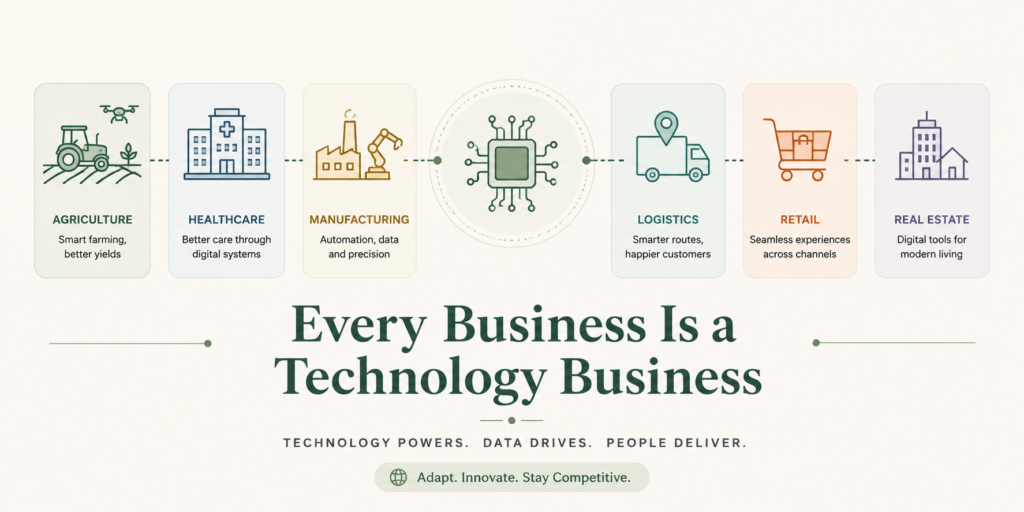
One of the clearest signs that every business is becoming a technology business is the transformation happening across industries.
Agriculture
Agriculture has evolved far beyond traditional farming methods.
Farmers now use satellite imagery, weather forecasting models, IoT sensors, drones, and data analytics to improve crop yields while reducing waste. Livestock operations monitor animal health using wearable devices, and supply chains use digital systems to track products from farm to market.
Technology enables farmers to make better decisions with greater precision.
Healthcare
Healthcare increasingly relies on digital systems to improve patient outcomes and operational efficiency.
Electronic health records reduce paperwork and improve continuity of care. Telemedicine expands access to specialists regardless of location. AI assists clinicians in identifying patterns that may be difficult to detect manually, while wearable devices allow continuous monitoring of chronic conditions.
Technology doesn’t replace healthcare professionals—it enhances their ability to deliver quality care.
Manufacturing
Modern manufacturing is powered by automation, robotics, predictive maintenance, and real-time monitoring.
Factories collect data from machines to anticipate failures before they occur. Digital twins simulate production environments, allowing companies to test improvements virtually before implementing them physically.
Manufacturing competitiveness increasingly depends on digital capabilities rather than production capacity alone.
Logistics and Transportation
Customers now expect to know where their packages are at every stage of delivery.
Meeting that expectation requires GPS tracking, route optimization, warehouse automation, predictive analytics, and integrated inventory systems.
Behind every successful logistics company is a sophisticated technology infrastructure coordinating thousands of moving parts.
Retail
Retail has become an omnichannel experience.
Customers may discover products on social media, compare prices on their phones, purchase through a website, collect in-store, and request support through messaging platforms.
Retailers must manage inventory, payments, marketing, customer service, and fulfillment across multiple digital touchpoints.
The shopping experience is now as much about technology as it is about merchandise.
Real Estate
Real estate has embraced digital transformation in remarkable ways.
Prospective buyers take virtual tours before visiting properties. Digital platforms simplify property searches, document management, and customer communication. Developers use Building Information Modeling (BIM) to improve planning and reduce construction errors, while property managers rely on software to oversee maintenance, tenant communication, and financial reporting.
The industry remains rooted in physical assets, but its efficiency increasingly depends on digital systems.
Data Is the New Competitive Advantage
Businesses often describe data as the new oil, but a more accurate comparison is that data has become the new compass.
Data helps organizations understand customer behavior, identify operational bottlenecks, forecast demand, and evaluate strategic decisions.
Without reliable data, leaders often rely on assumptions.
With reliable data, they make informed decisions.
The companies that consistently outperform competitors are rarely those with the most data. They are the ones that know how to transform information into action.
Technology Should Support Strategy, Not Replace It
While technology is essential, simply buying software does not make an organization innovative.
Many businesses invest heavily in digital tools without clearly understanding the problems they are trying to solve.
Technology should always support business strategy.
Before adopting any new platform or system, leaders should ask:
- What business problem are we solving?
- How will this improve the customer experience?
- Will this reduce costs or increase efficiency?
- Can our team successfully adopt it?
- How will we measure success?
Technology without strategy creates complexity. Technology aligned with strategy creates competitive advantage.
The Businesses That Thrive Will Be the Ones That Adapt
History is filled with examples of successful companies that struggled because they underestimated technological change.
Digital transformation is not about replacing people with software. It is about enabling people to do their work more effectively, make smarter decisions, and create better experiences for customers.
Organizations that embrace continuous learning, invest in digital capabilities, and encourage innovation are better positioned to respond to changing markets.
Those that resist change risk becoming less relevant over time.
Final Thoughts
The businesses that will lead tomorrow won’t necessarily be the ones with the biggest budgets or the longest history. They’ll be the ones that recognize technology is no longer a supporting function; it’s woven into how they create value, serve customers, and make decisions.
Digital transformation isn’t a destination with a finish line. It’s an ongoing commitment to learning, adapting, and improving.
So, here’s a question worth reflecting on:
If technology disappeared from your business tomorrow, what would stop working first?
Your sales? Your customer service? Your accounting? Your operations? Your marketing? Or would your entire business grind to a halt?
The answer reveals an important truth: you’re probably already a technology business.
The only remaining question is whether you’re treating technology as a strategic advantage or merely another operational expense.